
How Should Sweden Finance and Deliver the Infrastructure of the Future?
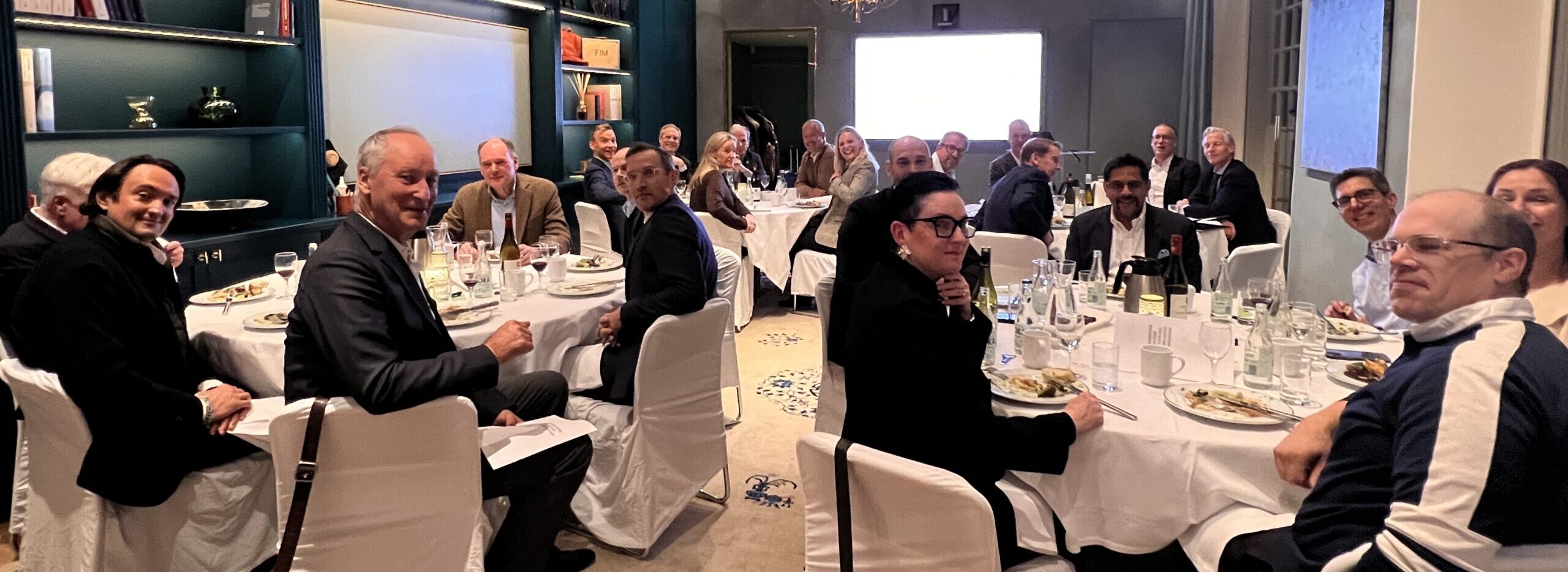
Clean water from the tap, trains that run, and reliable electricity when it’s needed. Much of what we take for granted rests on infrastructure that takes decades to build — and that Sweden now largely needs to renew and reinforce. How it should be prioritized, financed, and delivered was at the center of the discussion when the Karl-Adam Bonnier Foundation, together with the House of Governance and Public Policy at the Stockholm School of Economics, hosted a dinner conversation on 10 November about a planned research and education initiative on infrastructure.
Sweden faces extensive investment needs across energy, transport, water and sewage, and digital and preparedness-related infrastructure. These are challenges that are rarely purely technical. They also involve private and public financing, socioeconomic priorities, permitting, coordination, and governance across infrastructure’s entire life cycle. How should Sweden prioritize, finance, and deliver the infrastructure that society needs and that takes decades to build?
Long-term thinking, coordination, and leadership
The evening was opened by Professors Erik Berglöf and Karl Wennberg, who noted that infrastructure has been a focus since the House of Governance and Public Policy was founded, and has become even more pressing in light of the deteriorating security situation.
Erik Berglöf, with extensive experience from the Asian Infrastructure Investment Bank among others, described every infrastructure project as a kind of experiment: complex and long-term, often with a quarter of a century between the initial idea and the finished facility. In his experience, the most successful projects are not primarily about technology, but about the ability to unite the actors around a shared goal. That requires stable and predictable policy, long-term trust, and clear leadership.
He also broadened the picture of what infrastructure is. Nature and the environment, he said, are our most fundamental infrastructure, and he pointed to how tools for infrastructure investment are increasingly being applied to environmental issues as well. At the same time, he highlighted the need to factor a health perspective into how we invest in infrastructure.
Karl Wennberg picked up on the need to work across boundaries. “Society has problems, we have departments,” he summarized, noting that society’s challenges are rarely confined to a single discipline or sector. The question he posed was what research and educational expertise Sweden needs in order to strengthen its capacity to deliver, and how academia, business, government agencies, and politics can together develop the knowledge and leadership that sustainable solutions require.
Shared themes from the conversation
Several themes recurred in the table discussions that followed. One was the tension between infrastructure’s long time horizons, often 20 to 30 years, and the considerably shorter political and budgetary cycles. In connection with this, the discussion considered whether the state might keep a balance sheet and an investment budget as a way of treating infrastructure more as a long-term asset, and one that would make deferred maintenance far more visible. Another theme was the difficulty of moving complex projects forward when many actors are involved but no single one controls the whole; coordination both between public agencies and between the public and private sectors was described as essential but difficult.
Participants also discussed the challenge of procuring long-term functionality when future needs and technical solutions are uncertain, as well as the need for stronger procurement expertise. Another question was how risk can be shared and projects de-risked so that both public and private capital can contribute to investments that are worthwhile for society as a whole.
Throughout, the importance of infrastructure for the social contract was also emphasized. That basic functions such as clean water, the electricity grid, roads, and railways actually work is a foundation for citizens’ trust in society — a trust that becomes especially important in a time of heightened preparedness.
Toward a new initiative
In closing, Karl Wennberg presented the Stockholm School of Economics’ thinking on a forthcoming infrastructure-focused initiative within the House of Governance and Public Policy, the SSE Infrastructure Initiative, and what such an effort might encompass. In this way, the conversation served both as a source of insight and as a springboard for shaping a new research center that can strengthen Sweden’s ability to plan, finance, and deliver the infrastructure of the future.
For the Karl-Adam Bonnier Foundation, this engagement reflects a conviction that long-term, cross-sector knowledge is vital to Sweden’s development. Robust, well-functioning infrastructure is a prerequisite for competitiveness, preparedness, and a functioning society and therefore a question that concerns us all.
If you would like to learn more about the SSE Infrastructure Initiative, or to discuss how you can take part in or contribute to the initiative at the Stockholm School of Economics, please contact jonas.tornblom@hhs.se.

