
From the College of Europe to a Career in European Affairs
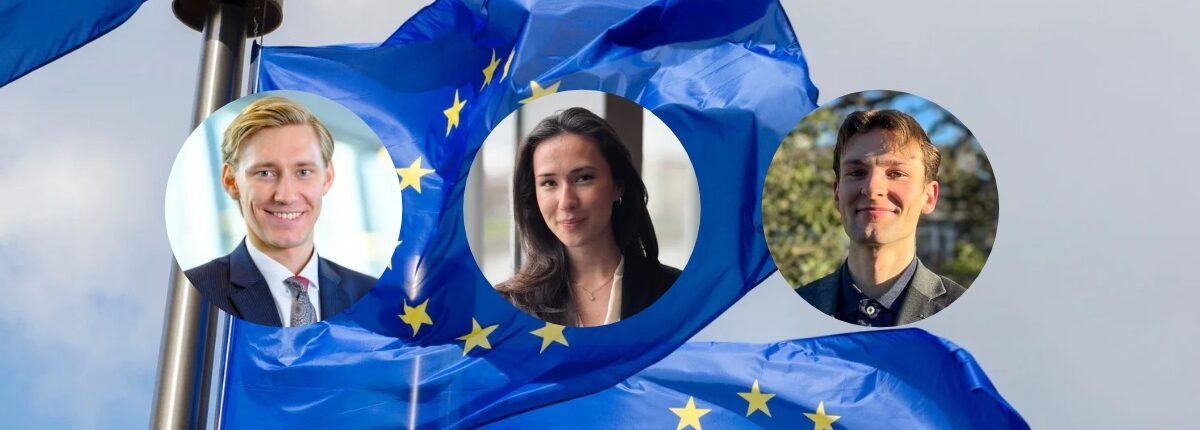
A year ago, Arezo Akbari, Leo Liljeberg Hallonsten, and Elias Ripstrand received the Karl-Adam Bonnier Foundation’s scholarship to study at the College of Europe in Bruges. The scholarship was created in response to a worrying trend: Sweden is underrepresented in the EU’s institutions, not least in the Commission, even as the decisions made in Brussels profoundly shape Swedish business and society. By helping more Swedes attend Europe’s most prestigious master’s program in EU affairs, the Foundation aims to strengthen Sweden’s voice in the Union over the long term. Now, a year on, the recipients look ahead and share their experiences.
From Bruges to the everyday work of the EU
The paths they have taken since graduating differ, but all three have taken clear steps toward a future in European and foreign affairs. After graduating, Arezo Akbari returned to Sweden’s Permanent Representation to the EU in Brussels, where she had previously been both an intern and an assistant in the financial affairs section. Today she is an assistant in the team for climate and business affairs, where her work includes preparing for meetings of the EU Council of Ministers. It gives her insight into issues such as the EU Emissions Trading System (ETS)—one of the highest priorities on the EU’s agenda.
– I noticed right away that what I’d learned at the College of Europe was useful in my everyday work. My colleagues valued it, and I had gained a deeper understanding of how the EU’s processes actually work, says Arezo Akbari.
Elias Ripstrand is currently in the Swedish Ministry for Foreign Affairs’ diplomat program and works as a desk officer in the Eastern Europe unit, focusing on Armenia and Azerbaijan. Admission to the program required a master’s degree, and he is convinced that his year in Bruges strengthened his application and was decisive in his acceptance.
Immediately after graduating, Leo Liljeberg Hallonsten traveled to Jordan to learn Arabic. Today he is back in Brussels, studying Arabic remotely. He sees the language as an asset for working with Arabic-speaking regions in the future.
A world-class education
All three describe their time at the College of Europe as academically demanding, socially intense, and highly rewarding. With 350 students on campus—around fifteen of them Swedish—the school is reminiscent of a boarding school, where students live and study alongside motivated people who share an interest in the same issues.
– The faculty were experts in their respective fields and had often written the course literature themselves. I was impressed by the level, and I came away with both a network and an understanding that help me moving forward. But it’s no ‘golden ticket’ to the Commission—you have to bring the drive yourself, says Elias Ripstrand.
The program combined academic depth with practical insights drawn from the EU and the real world.
– I thought I already knew the EU. Then I came to the College of Europe and truly learned it! We were taught by practitioners in senior positions within the EU and the World Bank. They could explain how the EU’s economic policy works right now, and the school was always up to date on the ongoing negotiations. That gave me real momentum when I returned to work, says Arezo Akbari.
They point to the encounter with other countries’ perspectives, and the networking, as one of the greatest rewards.
– It’s set up for building new connections with people from many different countries, and you grow very close. That’s something I’ll carry with me, along with all the knowledge and experience, says Leo Liljeberg Hallonsten.
Support that made all the difference
For all three, the scholarship was a prerequisite for the education to be possible at all.
– Education in Sweden is free of charge, so the step up to a school like the College of Europe is a big one. I couldn’t have accepted my place without the Foundation’s support, says Leo Liljeberg Hallonsten.
For Arezo Akbari, who came to Sweden as a first-generation immigrant from Afghanistan, the support was just as decisive.
– Without the financial support, it simply wouldn’t have been possible. The scholarship was absolutely decisive in making my studies at the College of Europe possible, says Arezo Akbari.
Looking ahead
Their ambitions reach toward the great questions facing Europe and the world. Arezo Akbari is aiming for the European Commission and its work on economic and financial affairs, but she is also interested in the Commission’s delegations abroad—ideally with a focus on the Middle East or Central Asia. Leo Liljeberg Hallonsten is drawn to the EU’s diplomatic service and to work on human rights and humanitarian aid, a direction sparked by certain courses in Bruges. Elias Ripstrand wants to continue as a diplomat, preferably in Brussels.
This is precisely the development the Foundation hopes to see: Swedes with top expertise making their way into the institutions and arenas where Europe’s future is shaped.
– It’s inspiring to hear the recipients’ thoughts about the future and their wish to help strengthen Sweden’s voice in the Union. That matters for the long-term development of both business and society, says Tor Bonnier, CEO of the Karl-Adam Bonnier Foundation.

