"Bridge-building matters more than ever"
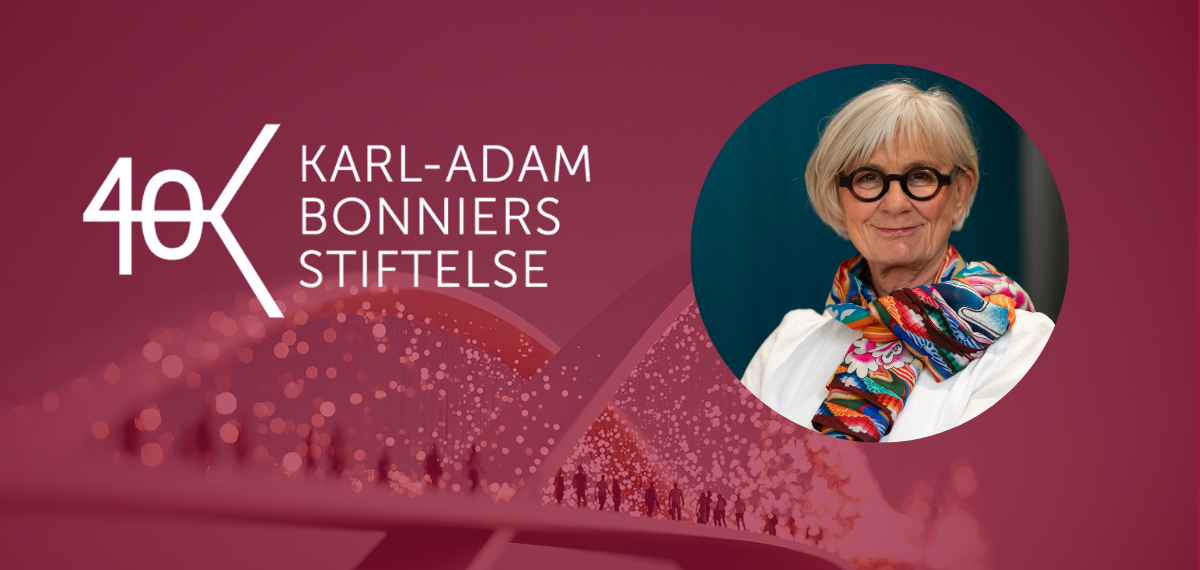
At a time when major and increasingly complex challenges can rarely be solved by a single actor alone, the need to build bridges between business, academia, and the public sector has become more evident than ever. The foundation’s role as an independent arena, where decision-makers and experts from different fields can genuinely meet and exchange perspectives, is therefore more important than ever. That is according to Kia Orback Pettersson, Chair of the Karl-Adam Bonnier Foundation for just over a year.
When Kia Orback Pettersson joined the board in 2020, it was already clear that Sweden was facing competitiveness challenges that could not be solved by business alone. Issues such as talent supply, energy, infrastructure, and security had become increasingly important for companies’ ability to grow and compete. The pandemic also served as a clear reminder of how interconnected different parts of society truly are. “Together” had become a guiding principle, both in society at large and in the corporate boards where she served.
– There has been a growing realization that no single actor holds the entire solution. If we want to develop sustainably over time, business, academia, and the public sector need to understand each other better and work more closely together.
Business is shaped by society
This is also one reason why the foundation’s work has gradually expanded beyond traditional business issues to focus more broadly on the relationship between business and societal development.
– Sweden no longer has the same advantage we had in the 1960s. Other countries have caught up. To remain competitive, we need the right skills, a functioning healthcare system, and schools that deliver. Shared societal structures need to work better as competition intensifies. Otherwise, business development will struggle as well.
Bridge-building requires people to meet
The foundation’s role is not to take sides in discussions, but to create the right conditions for open and constructive conversations between people with different perspectives. According to Kia, that independence is essential.
– We do not promote our own agenda, but we do take responsibility for making sure conversations happen and that the climate for discussion is constructive. That creates a sense of trust that allows people to meet openly without discussions becoming stuck in positioning or lobbying.
At a time when much communication is fast-paced and public, she also believes the need for trusted and long-term conversations has increased.
– A few years ago, I thought the need for these kinds of arenas would decrease when everyone suddenly had their own platform on social media. But the opposite turned out to be true. Many people are simply shouting into the void. I believe the longing for spaces where we can have meaningful conversations is greater than ever.
She describes the foundation as a place where people from different backgrounds and perspectives come together to exchange insights, not negotiate positions.
– What takes place here is not negotiation. It is conversation. And that is where ideas begin to take shape and new insights emerge.
When conversations lead to action
Over time, the foundation has demonstrated that bridge-building can also lead to tangible change. Corporate Governance Forum (CGF), established in 1993, is one of the clearest examples. For more than three decades, CGF has brought together lawyers, business leaders, institutional investors, and policymakers around corporate governance issues, helping shape the Swedish model and influence legislation both in Sweden and within the EU.
– CGF has shown what a long-term and independent forum can accomplish. It is an impressive journey and something we can bring with us into the issues we are working on today.
One current example is the collaboration with the Stockholm School of Economics, where the foundation has helped establish House of Governance and Public Policy and the K-A Bonnier Center for Governance. Here, researchers, business leaders, and public-sector representatives come together around questions related to governance and societal development, often through interdisciplinary conversations that otherwise would rarely take place.
– The idea is that decision-makers should have access to the right knowledge and research when making decisions that shape the future. And they should bring perspectives from both the private and public sectors into those discussions. I am convinced that environments where research and practice come closer together are essential for strengthening long-term competitiveness.
Accelerating the journey from conversation to action
Looking ahead, Kia wants the foundation to continue evolving alongside a world that is becoming increasingly interconnected and complex. The more difficult the challenges become, the more important it is to bring together people with different perspectives and build bridges across experiences, sectors, and ideas.
– I want us to become even better at creating momentum from conversation to action. We have an incredible network and a unique opportunity to bring together people who both want to contribute to change and have the ability to do so.
She sees the foundation as an enabler that helps others take the next step, rather than always leading from the front.
– We want to be a place where people meet, challenge each other’s perspectives, and bring new ideas back into their own organizations. That is how conversations here are transformed into action and contribute to long-term development and competitiveness, Kia concludes.