What forms the future relations between the EU, the US and China?
The world is changing rapidly. The geopolitical and geoeconomic shifts now reshaping the global order carry profound consequences for Swedish and European companies operating internationally. To examine these changes and contribute to a focused analysis of where we stand and where we are heading, the Karl-Adam Bonnier Foundation is arranging a series of two seminars. The first was held on June 8th.
The question is highly topical. The relationship between Europe, China and the United States now shapes the conditions for almost every company with international operations, and the situation is moving quickly. Must companies choose a side, or are commercial relationships with both China and the US possible, and if so, on what terms? These were the questions that framed the evening.
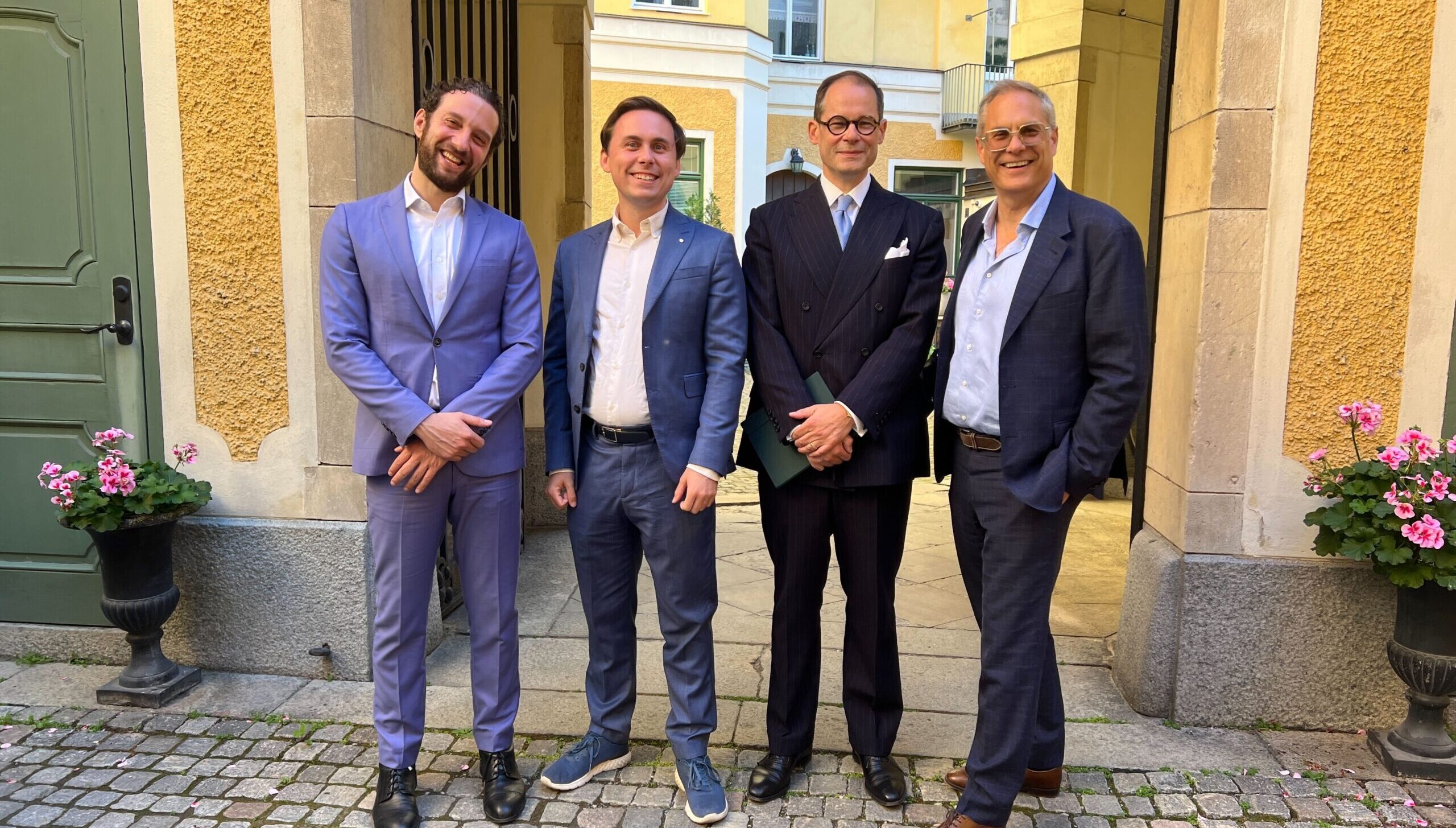
The Foundation’s role here is to bring different perspectives together for a constructive dialogue. The evening’s two opening speakers approached the subject from somewhat different angles. Isaac Stone Fish, founder and CEO of the analysis firm Strategy Risks in New York, brought a security and risk perspective. Fredrik Erixon, founder and director of the think tank ECIPE in Brussels, brought a trade and competitiveness perspective. The conversation was moderated by Nick Andersson of the Stockholm School of Economics.
Stone Fish described a worrying trajectory. He argues that the EU is now beginning to realize that Europe is overexposed to China, the same realization the US reached five or six years ago. One of his most prominent points was that he expects a coming war between the US and China, one that would force the parties to take sides. The question he raised was where the EU would position itself in such a scenario. He also noted that the EU does not act as one, and that China understands how business relationships with European companies can be used to advance Beijing’s interests.
Erixon was more measured on the risk of war and focused instead on trade patterns. He has long warned that a full decoupling from China would be economically damaging, given Europe’s deep dependence on Chinese supply chains, while de-risking in strategic areas carries its own costs. He described how the EU and China are drifting apart in some areas yet remain closely intertwined, and how Europe’s relative economic weight in the world risks declining over time.
The discussion that followed returned to several themes: that the EU is caught between two great powers while its 27 member states pursue different lines, that the union is fragmented particularly in defense and high technology, and that the question of a common China strategy, de-risking or decoupling, is now beginning to be discussed in earnest. Participants also touched on how companies entering new markets can rarely afford to pursue several at once, and how the choice can then come down to China or the US.
This was the first of two seminars. The second will turn from analysis to solutions, focusing on what Sweden and the EU can do to improve the conditions for companies doing international business.