
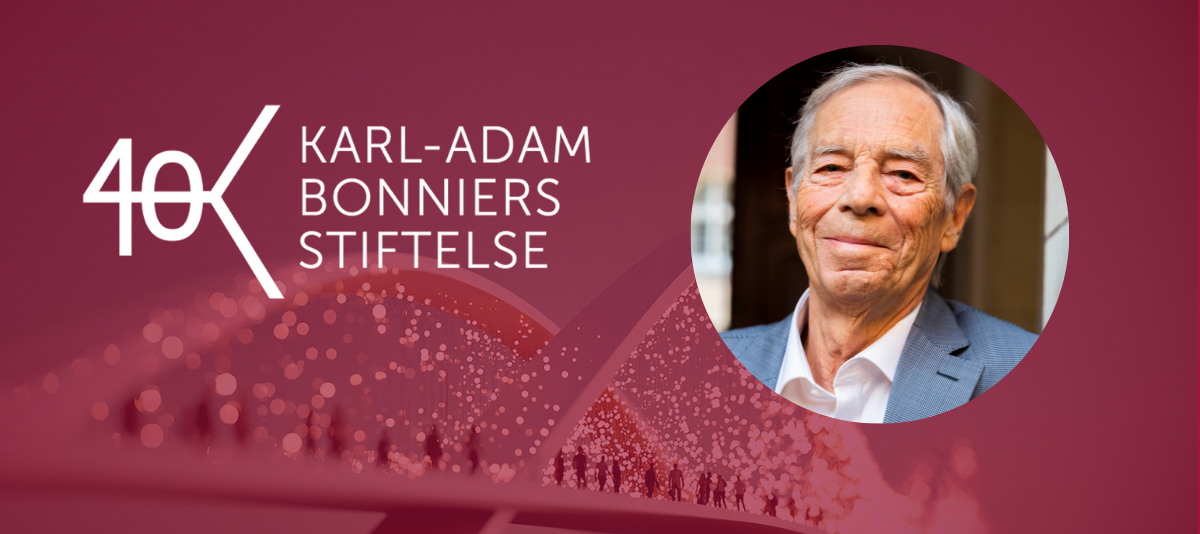
"There is just as much to do today as there was then"
When Karl-Adam Bonnier founded the Karl-Adam Bonnier Foundation that bears his name, the ambition was to contribute to the long-term development of Swedish business. Forty years later, much has changed since the foundation was established, yet its mission remains just as relevant today. Here, Karl-Adam reflects on the original idea behind the foundation and why it
continues to matter.
In 1986, Karl-Adam Bonnier had recently sold his majority stake in the family business that he had built and developed over two decades. One chapter had come to an end, but he did not feel finished.
– I was very grateful for my success in business and wanted to give something back. I also had six children at the time and wanted to create a future opportunity for them to get involved, Karl-Adam recalls.
Out of these two ambitions, the idea for the Karl-Adam Bonnier Foundation was born.
Supporting Swedish business development
The foundation’s direction came naturally. Karl-Adam himself had spent 20 years as a business leader while also studying business administration and corporate governance at an American university. The focus therefore became supporting research and education in business administration and corporate law, fields that help shape the conditions under which Swedish companies operate.
The vision was simple yet ambitious: the foundation would serve Swedish business from a long-term perspective.
– It has turned out much as I had hoped. With relatively limited resources, the foundation has managed to create a relevant platform for discussions about the conditions facing Swedish businesses, and we have had a meaningful influence on the broader conversation.
An arena for constructive dialogue
Over the years, the foundation has awarded scholarships, established collaborations with academia, funded research, and published reports and publications. But when Karl-Adam is asked what he is most proud of, the answer is clear: the seminars.
Business leaders, experts, and decision-makers gather there to discuss current issues. The format has remained largely unchanged since the beginning, built around Chatham House rules, a shared dinner, personal invitations, and space for open discussion.
– We have managed to bring knowledgeable people together around relevant issues in an informal and relaxed setting, with good food and conversation. My impression is that participants have felt comfortable expressing their views on current and sometimes controversial topics. There has always been a high ceiling and an open atmosphere for discussion.
According to Karl-Adam, that tone is exactly what has built the foundation’s credibility over time.
Just as relevant today as in 1986
From the very beginning, each new board was given considerable freedom to shape the organization in its own way. Karl-Adam had seen in other contexts how boards that remained unchanged for too long could lose energy and momentum. To maintain renewal and engagement, he decided that the board should be refreshed regularly. With each new board came new perspectives, new questions, and continued development of the foundation’s work.
As the foundation celebrates its 40th anniversary, Karl-Adam looks to the future with confidence. The original idea, to serve as an independent, long-term platform for discussions about the conditions and development of business, is, in his view, just as relevant today as it was in 1986.
– We have worked on issues that I initially believed would be solved within a few years. But business and society are constantly changing, and there is a continued need for organizations that can follow and contribute to that development over time. Foundations have an advantage in that respect because they can work with a truly long-term perspective. There is just as much to do today as there was in 1986. The world is changing too quickly for us ever to be finished, concludes Karl-Adam.